New Possibilities for Ovarian Cancer Testing with Upcon® Technology
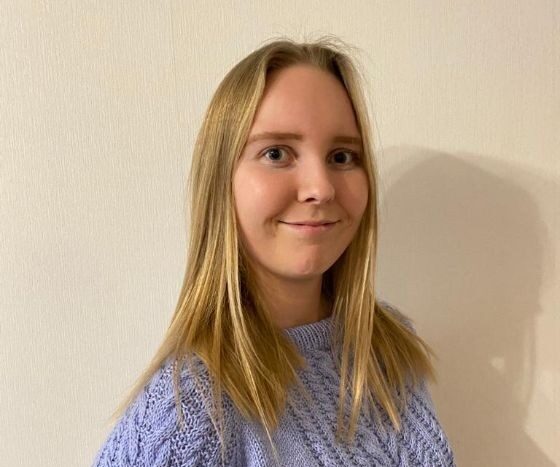
A poster by Venla Saramäki at Rapid Methods Europe 2026
Interview: Venla Saramäki Poster Title: “A quantitative upconverting nanoparticle–based lateral flow platform demonstrated through a whole blood ovarian cancer assay”
The work explores how advanced nanoparticle-based detection can enable more sensitive and quantitative ovarian cancer testing directly from whole blood samples.
Venla, can you briefly describe your background and your current work?
I work as a R&D Chemist at Uniogen, where I develop lateral flow diagnostic tests using upconverting nanoparticle (UCNP) technology. At the moment, I’m working on a novel point-of-care test aimed at improving ovarian cancer diagnostics, which has been a particularly motivating project for me. I joined Uniogen in 2022, just as I was about to complete my master’s degree in molecular biotechnology and diagnostics. Since 2020, I have gained experience in lateral flow assays across areas such as cancer, infectious diseases, and hormone diagnostics. I think I ended up in this field largely because I enjoy problem‑solving and improving assay performance.
What is the focus of the poster you’re presenting at Rapid Methods 2026?
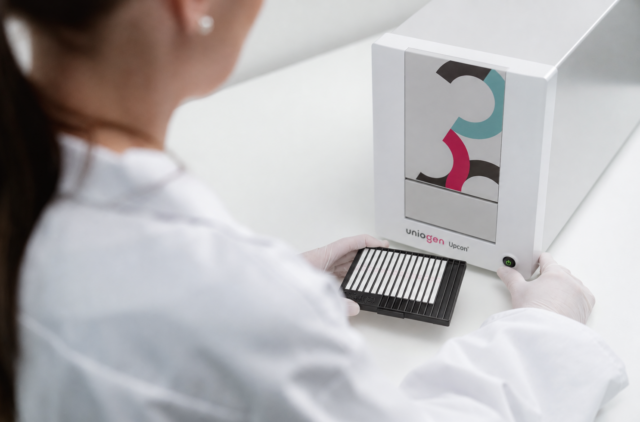
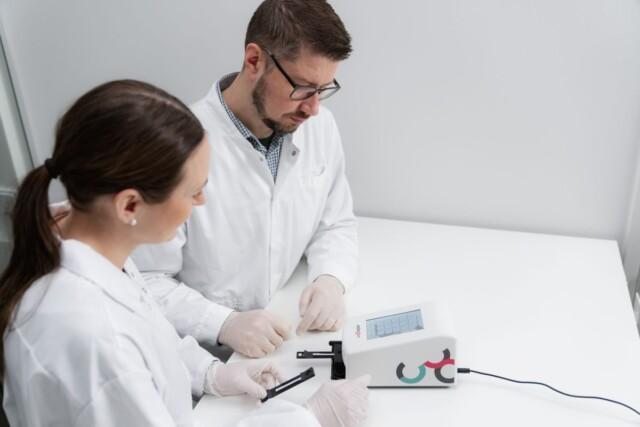
The poster focuses on improving rapid diagnostic testing and making it more reliable under realistic clinical conditions. In particular, the work addresses how accurate and quantitative results can be achieved from challenging samples such as whole blood, where background signals and matrix effects often limit performance. A key focus of the study is minimizing background interference while maintaining high analytical sensitivity. We used an ovarian cancer–related biomarker as a model, because in that case detecting low concentrations is critical, so good linearity and robustness are essential for making the results clinically meaningful. What enables this approach is the use of upconverting nanoparticles (UCNPs) together with Upcon reader instruments, which give very low background signals and make it possible to perform sensitive and quantitative measurements even in complex biological samples.
Why are upconverting nanoparticles particularly well suited for this application?
Upconverting nanoparticles (UCNPs) are particularly well suited for this application because of their unique optical properties. They are excited with near‑infrared light but emit visible light, which means their signal is essentially free from the autofluorescence that typically interferes with conventional fluorescence-based assays. Upconverting nanoparticle (UCNP) emission occurs at wavelengths that are well separated from the main absorption range of hemoglobin, so the signal is not significantly affected by the sample itself. In addition, the nanoparticles are thinly coated, which allows them to flow efficiently along the lateral flow strip and support stable assay performance. Overall, this combination of reduced background noise, minimal interference, and good flow behaviour makes them very effective for achieving sensitive and quantitative detection, even in complex samples like whole blood.
What were the main technical challenges when working with whole blood in a lateral flow format?
Working with whole blood in lateral flow assays is challenging due to high background and matrix interference from components like hemoglobin, which obscure low signals. Red blood cells can also clog membranes, requiring lysis for proper flow, while maintaining sensitivity and quantitative accuracy in such a complex matrix remains difficult.
How does this work fit into broader trends in rapid diagnostics?
This work reflects a shift in rapid diagnostics toward more sensitive, quantitative point‑of‑care tests using whole blood instead of separated samples. By combining advanced detection methods with dedicated readers, it reduces background interference and enables fast, reliable, and clinically meaningful results.
Why is Rapid Methods 2026 the right venue for presenting this work?
This is a highly relevant venue for the work because it focuses on advanced technologies that improve the performance of rapid testing. The conference brings together people working on new detection methods, assay formats, and point‑of‑care solutions, so the topic fits well within that scope. Our work addresses key challenges in the field, such as achieving low background, high sensitivity, and quantitative readout in rapid formats, which are highly relevant to the audience. At the same time, it demonstrates how these improvements can be translated into practical applications using whole blood and dedicated reader systems.
What do you hope the audience takes away from your poster presentation?
I hope the audience takes away that it’s possible to combine the speed of rapid tests with the performance typically associated with laboratory methods. I want to show that even challenging sample types like whole blood can be used for reliable and quantitative detection when the technology is optimized well. I also hope it opens up discussion. I’d be really interested in hearing about others’ assays, the challenges they’re facing, and the kinds of solutions they’re developing. For me, it’s not only about presenting results, but also about exchanging ideas and having those conversations with people working on similar problems.
What do you find most interesting in developing new diagnostic technologies?
What I find most interesting is the problem‑solving aspect. I really enjoy building on what I’ve learned and experienced but also thinking outside the box to find new solutions. It requires understanding different areas, like chemistry, materials, and detection methods, and how they all work together. It’s always very rewarding when you finally find a solution that clearly improves the assay. I also enjoy the challenge and working on new things. Developing an assay sometimes feels like solving a puzzle, where many components need to come together to form a working whole. I also really value brainstorming sessions with the team, where you can exchange ideas and look at problems from different perspectives. And of course, it’s motivating to know that the final product can have a real impact for the end users.
Venla Saramäki – R&D Scientist and Lateral Flow Assay Developer, Uniogen
Venla has been specialized in lateral flow immunoassay development since 2020, working on infectious disease, cancer, and hormone-based in vitro diagnostics. Since 2022, Venla has gained experience with up‑converting nanoparticles (UCNPs) as well as europium nanoparticles. At Uniogen, Venla plays a key role in the development laboratory for lateral flow assays.
Venla is a motivated problem solver who enjoys challenges and continuous learning, both professionally and personally. At Uniogen Venla creates a positive aura during coffee breaks and is always first in solving crossword puzzles!
Venla is available at RME 2026 June 8th-10th during poster viewing hours! Click here to view the programme.
Cancer research utilizing Upcon®:
- Bayoumi et al., 2020 – Glycovariant-based lateral flow immunoassay for CA125 detection
- Islam et al., 2025 – High-sensitivity detection of urinary extracellular vesicles