Upconverting Nanoparticles (UCNPs) in Lateral Flow Immunoassays: Benefits and Applications
By Ida Erling, MSc Physics, Sales manager – Team Lead
Lateral flow immunoassays (LFIAs) are widely used when fast and straightforward testing is required. However, applications requiring high analytical sensitivity, quantitative results or measurement from challenging sample matrices can place greater demands on the detection technology.
Upconverting nanoparticles (UCNPs) are luminescent labels that convert low-energy near-infrared (NIR) excitation into higher-energy emission at visible wavelengths. In lateral flow immunoassays, this unique optical mechanism enables sensitive quantitative detection with very low optical background.
Combined with high photostability, stable signal after drying, and multiplexing potential, these properties make UCNPs an interesting label technology for sensitive lateral flow assays.
What are upconverting nanoparticles?
Photon upconverting nanoparticles are inorganic nanocrystals containing lanthanide ions. Their defining optical property is their ability to absorb low-energy NIR excitation and emit higher-energy light at shorter wavelengths.
This phenomenon is known as photon upconversion or anti-Stokes photoluminescence. Photon upconversion involves the sequential absorption of multiple excitation photons followed by the emission of a higher-energy photon. This differs fundamentally from conventional fluorescence, where the emitted photon has lower energy than the excitation photon.
For lateral flow applications, this difference provides an important advantage: very low optical background.
Why use UCNPs in lateral flow immunoassays?
When conventional fluorescent labels are excited, biological materials in the sample can also produce autofluorescence. This background can make weak assay signals more difficult to distinguish.
UCNP detection uses NIR excitation, which produces minimal autofluorescence from biological materials. NIR excitation is also weakly absorbed by many biological materials. The result is a detection principle capable of producing a high signal-to-background ratio — an important characteristic when developing sensitive quantitative lateral flow assays.
UCNPs also provide several additional properties that are valuable in LFIA development:
- High photostability
UCNPs have high photostability and can tolerate prolonged excitation at high intensity without the photobleaching associated with many conventional fluorescent labels.
The same lateral flow strip can therefore be excited and measured repeatedly. This also enables test strips to be remeasured after storage. - Stable signal after drying
UCNP emission is retained after the nanoparticles have been dried onto lateral flow conjugate pads and stored.
This is particularly relevant for lateral flow applications, where labelled conjugates are commonly incorporated into a dry test format and must remain stable during storage. - Narrow emission bands and large anti-Stoke’s shift
UCNPs share several useful optical characteristics with other lanthanide-based labels, including narrow emission bands and long emission lifetimes.
Their large anti-Stokes shift also provides clear spectral separation between NIR excitation and the higher-energy emission used for detection.
How do UCNPs work in lateral flow assays?
In a UCNP-based lateral flow immunoassay, upconverting nanoparticles are conjugated to a biological binder element, such as an antibody.
As the sample migrates through the lateral flow strip, the UCNP-labelled conjugates participate in specific binding reactions. Depending on the assay architecture, nanoparticles accumulate at the test and control lines.
A compatible UCNP reader then illuminates the strip using NIR excitation and quantitatively measures the upconverted emission. Because the optical background under NIR excitation is very low, relatively weak signals can be distinguished from the background. This makes UCNPs particularly interesting for applications requiring sensitive, instrument-read lateral flow detection.
Can UCNPs be used with whole blood?
UCNPs are well suited to detection from challenging biological sample matrices.
NIR excitation produces minimal autofluorescence and is weakly absorbed by many biological materials. These characteristics make UCNPs suitable for signal detection from matrices such as whole blood.
The analytical performance of a whole-blood lateral flow assay will naturally depend on the complete assay system, including sample handling, membrane, antibodies, conjugates, buffers and assay architecture, but UCNPs can reduce optical interference during signal detection.
Can UCNPs be used for multiplex lateral flow assays?
Another interesting characteristic of upconverting nanoparticles is their potential for multiplex detection.
The optical properties of UCNPs can be modified by changing their composition and lanthanide activators. Different UCNP compositions can therefore emit light at different wavelengths while using the same excitation source.
This provides a route toward lateral flow assays in which different UCNP labels represent different analytes and can be differentiated based on their emission characteristics.
UCNPs therefore offer an interesting platform for developing multiplex quantitative lateral flow assays.
UCNPs vs. conventional fluorescent labels in lateral flow assays
Both UCNPs and conventional fluorescent labels can be used for quantitative lateral flow detection, but their optical properties differ.
| Property | Upconverting nanoparticles | Conventional fluorescent labels |
| Excitation | Near-infrared | Typically UV or visible |
| Emission | Higher energy that excitation | Lower energy than excitation |
| Autofluorescence | Very low under NIR-excitation | Can contribute background |
| Photostability | High | Label-dependent |
| Repeated excitation | Well suited | Label-dependent |
| Quantitative detection | Yes | Yes |
| Multiplexing | Possible using different UCNP compositions | Possible using different fluorophores |
The optimal label depends on the assay and its performance requirements. UCNPs become particularly attractive when low background, high sensitivity, photostability, and quantitative detection are priorities.
Applications of UCNP-based lateral flow assays
The combination of low-background detection, photostability and quantitative measurement makes UCNPs relevant to a wide range of lateral flow applications.
Potential applications include:
- point-of-care diagnostics
- clinical testing
- food safety testing
- environmental monitoring
- other applications requiring sensitive quantitative lateral flow detection
UCNP-based lateral flow immunoassays can be particularly useful when visual interpretation does not provide sufficient analytical sensitivity or when a quantitative result is required.
Multiple scientific studies have demonstrated the use of upconverting nanoparticles in sensitive lateral flow immunoassays across different applications. Recent articles include e.g.,:
- Ekman et al. 2026, where UCNPs were utilized in a mixed-format lateral flow assay enabling duplex quantification of ferritin and sTfR.
- Islam et al. 2023, where UCNPs were used as ultra-bright labels in a lateral flow assay to detect cancer-related extracellular vesicles with high precision.
How are UCNP lateral flow assays measured?
UCNP-based lateral flow assays require an optical reader capable of providing the appropriate NIR excitation and measuring the resulting upconverted emission. For commercial applications, small portable readers are typically used.
For research and assay development, the reader can also influence the efficiency of the development workflow. Screening antibody pairs, membranes, buffers, and assay architectures can require measurements of tens or hundreds of experimental strips.
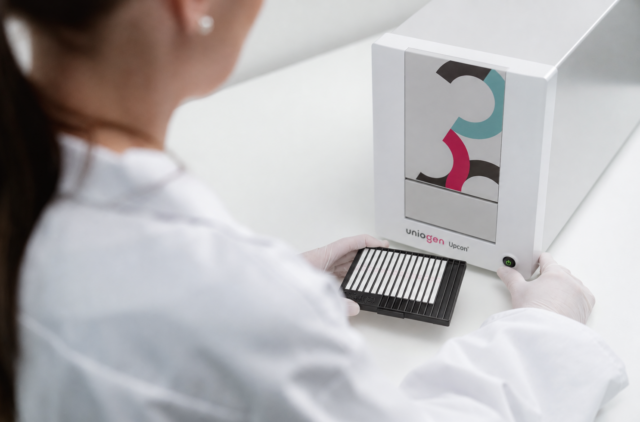
Uniogen’s ReadY Upcon benchtop reader provides quantitative UCNP detection for lateral flow strips and supports parallel measurement of up to 19 strips per loading.
Sensitive quantitative detection for lateral flow immunoassays
Upconverting nanoparticles combine very low optical background, high photostability, stable emission and multiplexing potential in a label technology suitable for sensitive quantitative lateral flow assays.
For assay developers, realizing these advantages requires both a well-optimized assay and an appropriate detection system.
Interested in using UCNPs for quantitative lateral flow detection? Explore Uniogen’s Upcon® upconverting nanoparticle products or contact us to discuss your application.
Author:

Ida Erling, M.Sc Physics, Sales Manager
Ida has spent most of her career in working with sensitive detection technologies in life science and diagnostics industry. Her career started in optics design and instrument R&D and later expanded into product management and commercialization. With a background in physics and additional studies in chemistry, she approaches photon upconversion with both scientific curiosity and a practical interest in how the technology can be turned into working solutions. Today, Ida works as Sales Manager and Team Lead at Uniogen. She leads a team commercializing Upcon® technology and helping customers bring the benefits of upconverting nanoparticles into their own products.
Frequently asked questions about the use of UCNPs in lateral flow immunoassays
Upconverting nanoparticles, or UCNPs, are inorganic nanocrystals containing lanthanide ions that absorb low-energy near-infrared light and emit higher-energy light at shorter wavelengths. This photon upconversion mechanism enables luminescence detection with very low optical background.
UCNPs combine very low background under NIR excitation with high photostability, narrow emission bands and stable signals after drying. These properties make them particularly suitable as labels for sensitive, instrument-read and quantitative lateral flow immunoassays.
Yes. A compatible UCNP reader can excite the nanoparticles and quantitatively measure their emitted signal. This allows numerical analysis of test and control lines rather than relying solely on visual interpretation.
UCNP detection is suitable for challenging biological matrices because NIR excitation produces minimal autofluorescence and is weakly absorbed by many biological materials. This makes UCNPs an interesting label technology for whole-blood lateral flow assays.
Yes. Different UCNP compositions can generate distinguishable emission signals while using the same excitation source, providing opportunities for multiplex lateral flow assays designed to detect multiple analytes.

Interested in finding out if UCNPs could be the right solution for your lateral flow assay application?