How to Accelerate Lateral Flow Assay Development with Parallel Strip Scanning
By Ida Erling, MSc Physics, Sales manager – Team Lead
Developing a lateral flow assay is an iterative process. Antibody pairs, membranes, buffers, conjugates and assay architectures all need to be evaluated, and every optimization round can generate dozens or hundreds of lateral flow strips that need to be measured.
When strips are measured individually, the measurement workflow itself can become a bottleneck. Parallel lateral flow strip scanning allows assay developers to analyze multiple experimental strips from a single loading, reducing hands-on work and generating more quantitative data per day.
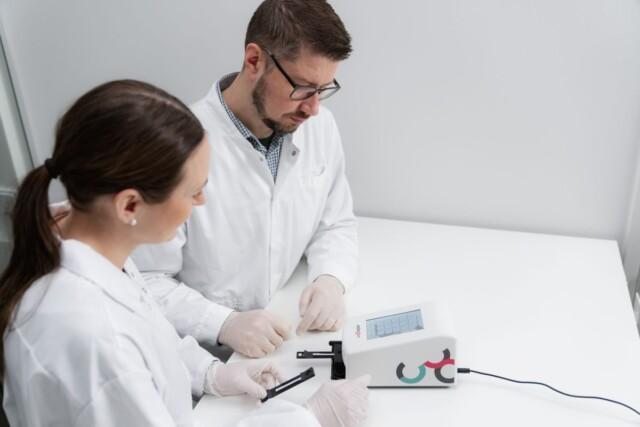
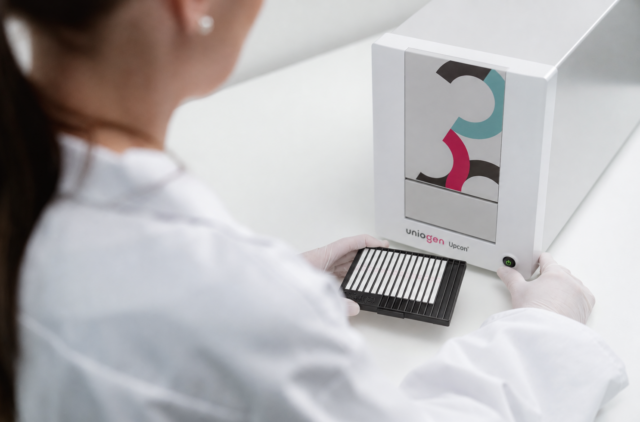
Uniogen’s ReadY Upcon benchtop reader can analyze up to 19 lateral flow strips from one loading in less than 10 minutes, making parallel quantitative measurement practical during lateral flow assay development and optimization.
Why does lateral flow assay development require so many measurements?
A high-performance lateral flow immunoassay rarely results from a single experimental condition.
Developers may need to systematically compare:
- antibody pairs
- antibody concentrations
- membranes
- buffers and buffer concentrations
- UCNP conjugates
- assay architectures
- other assay parameters
Testing combinations of these variables quickly multiplies the number of experimental strips.
The ability to run larger experiments is valuable because more data can help developers identify interactions between assay parameters and make better-informed optimization decisions.
But there is a practical problem: every strip needs to be measured.
The bottleneck of measuring lateral flow strips one at a time
During assayWith a conventional single-strip measurement workflow, those 100 strips require 100 separate loading runs. That creates repetitive hands-on work that adds little scientific value. As experiment sizes increase, researchers can spend considerable time simply loading, measuring and removing strips. Parallel measurement changes the workflow.
The ReadY Upcon reader accommodates up to 19 lateral flow strips in one loading. This means 100 strips can be covered in only six loadings instead of 100. The result is less repetitive handling and more efficient processing of larger lateral flow experiments.
How does parallel lateral flow strip scanning work?
ReadY Upcon performs quantitative full-strip scanning of UCNP-based lateral flow assays.
Up to 19 lateral flow strips can be loaded simultaneously and analyzed in less than 10 minutes. A complete scan of an individual strip takes approximately 30 seconds, and the scan is displayed in the software in real time. The scanned measurements from each strip are recorded into one export file, meaning that instead of repeatedly returning to the instrument after every individual measurement, developers can load a larger set of experimental strips together and easily export the resulting data for further analysis once the run is finished.
This makes parallel scanning particularly useful for systematic screening and optimization studies. Increasing measurement throughput allows larger experimental designs to be evaluated without creating a corresponding increase in repetitive instrument loading.
For iterative development, that translates into a simple advantage: more quantitative data can be generated within the available development time.
Quantitative UCNP detection with low background
ReadY Upcon is designed for quantitative detection of upconverting nanoparticles (UCNPs).
UCNPs convert near-infrared excitation into higher-energy emission. Because NIR excitation produces minimal autofluorescence from biological materials, photon upconversion enables very low-background optical detection.
With ReadY Upcon, background levels below 40 counts can be achieved. In Uniogen measurements, 10 pg of UCNPs can be detected with a signal-to-background ratio of 60.
The reader also provides excellent measurement reproducibility, supporting quantitative comparison between experimental assay conditions.
The analytical sensitivity of a complete lateral flow immunoassay depends on the entire assay system, including reagents, sample matrix, membrane and assay architecture, but sensitive and reproducible label detection provides a strong foundation for assay optimization.
Read more: Upconverting nanoparticles (UCNPs) in lateral flow immunoassays: benefits and applications.
Full-strip scanning provides more than a single measurement point
During assay development, information outside the test line can also be useful.
ReadY Upcon scans the complete lateral flow strip rather than measuring only a predefined point. The full strip scan is visible in the software in real time.
This provides developers with a quantitative view of signal distribution across the strip and can provide additional information when comparing experimental conditions.
From lateral flow measurement to UCNP conjugate quality control
ReadY Upcon is not limited to lateral flow strips. The same benchtop instrument can measure 6- to 1536-well microplate formats, allowing developers to use the reader in other UCNP workflows.
One important application is quality control of UCNP conjugates.
Using the same detection platform for both conjugate characterization and lateral flow measurement can simplify the analytical workflow during assay development.
For lateral flow assays utilizing europium nanoparticles, Uniogen also offers a corresponding reader platform for europium nanoparticle detection.
How much can parallel scanning reduce lateral flow measurement work?
The difference becomes particularly clear as experimental volume increases.
| Number of LF strips | Single-strip workflow | ReadY Upcon, up to 19 strips/loading |
| 19 | 19 loadings | 1 loading |
| 50 | 50 loadings | 3 loadings |
| 100 | 100 loadings | 6 loadings |
| 200 | 200 loadings | 11 loadings |
Parallel scanning does not eliminate the scientific work involved in lateral flow development. It reduces the repetitive measurement handling around that work. That allows researchers to spend more time designing experiments, interpreting results and deciding which conditions to take forward.
Generate more data from every LFIA development cycle
Lateral flow assay development will always require experimentation. The question is how much researcher time needs to be spent on the repetitive measurement process.
By analyzing up to 19 lateral flow strips per loading, ReadY Upcon enables developers to process larger experiments with fewer instrument-loading steps. Quantitative full-strip scanning, low-background UCNP detection and microplate compatibility further extend the platform from LFIA optimization to UCNP conjugate quality control.
Developing or optimizing a quantitative lateral flow assay? Contact Uniogen to discuss how ReadY Upcon could fit into your assay development workflow.
Author:

Ida Erling, M.Sc Physics, Sales Manager
Ida has spent most of her career in working with sensitive detection technologies in life science and diagnostics industry. Her career started in optics design and instrument R&D and later expanded into product management and commercialization. With a background in physics and additional studies in chemistry, she approaches photon upconversion with both scientific curiosity and a practical interest in how the technology can be turned into working solutions. Today, Ida works as Sales Manager and Team Lead at Uniogen. She leads a team commercializing Upcon® technology and helping customers bring the benefits of upconverting nanoparticles into their own products.

Interested in finding out if UCNPs could be the right solution for your lateral flow assay application?